The role of UPS power supply, purchase of Kehua uninterruptible power supply and introduction to UPS batteries
1. The role of UPS power supply
(1) Maintain continuous supply of electricity
In modern society, many critical equipment and systems do not tolerate power interruptions, such as data centers, life support equipment in hospitals, and transaction systems of financial institutions. UPS power supply can quickly switch to battery power supply mode when the mains power is interrupted. Generally speaking, the switching time can be controlled at the millisecond level, which is extremely critical to ensure the continued operation of the equipment. Taking the data center as an example, if the server suddenly loses power, a large amount of data being processed will be at risk of being lost, and the business will come to a standstill. The UPS power supply can ensure that servers and other equipment can continue to operate stably before the mains power returns to normal, maintain business continuity, and avoid huge economic losses and adverse effects caused by power outages.
(2) Improve power quality
During the transmission process of mains power, it is extremely susceptible to interference from various factors. There are problems such as surges (instantaneous high voltage), instantaneous low voltage, wire noise and frequency deviation. These problems are collectively referred to as "power pollution". For equipment that requires extremely high power supply stability, such as precision medical testing equipment, high-end scientific research instruments, etc., "power pollution" may cause abnormal operation of the equipment, deviation in test results, and even damage to equipment hardware. UPS power supply has functions such as voltage stabilization, frequency stabilization and filtering, which can effectively eliminate various interferences in the mains power, convert unstable mains power into pure and stable power output, provide high-quality power for equipment, ensure the normal operation of equipment, and extend the service life of equipment.
2. What equipment uses UPS power supply?
(1) Data center equipment
The data center is the core hub for the storage, processing and exchange of massive data. Key equipment such as servers, storage devices, network switches and routers cannot stop running for a moment. The server carries various business systems and data resources of the enterprise. Once the power is cut off, the data being processed in the memory is instantly lost, which not only affects the current business, but may also lead to serious consequences such as data damage and system crash. ; Storage devices store historical data and important information of enterprises. Power outages will interrupt the data writing process, resulting in data inconsistency or loss. ; Network switches and routers are responsible for data forwarding and routing. A power outage will interrupt network communications and cause the entire data center to lose contact with the outside world. Therefore, data centers are widely equipped with UPS power supplies to ensure that equipment can continue to operate when mains power fails and maintain the stable development of data services.
(2) Medical equipment
In hospitals, many medical equipment related to patient life safety have extremely high requirements on power stability. For example, if the life support equipment in the intensive care unit (ICU), such as ventilators, ECG monitors, infusion pumps, etc., lose power, it will directly threaten the lives of patients. ; If the surgical equipment in the operating room, such as shadowless lamps, anesthesia machines, electrosurgical machines, etc., suddenly lose power during the operation, not only the operation will not be able to proceed normally, but it may also bring serious medical risks to the patient. ; Medical testing equipment, such as biochemical analyzers, PCR detectors, etc., if the testing is interrupted due to power outage and the testing results are inaccurate, it will affect the doctor's judgment and treatment of the patient's condition. UPS power supplies provide reliable backup power for these medical equipment, ensuring the smooth progress of medical work and protecting the lives and health of patients.
(3) Financial transaction equipment
The trading systems of financial institutions, such as the trading hosts of stock exchanges and the core business systems of banks, process large amounts of financial transaction data in real time. During the transaction process, any brief power outage may cause transaction interruption, data loss, cause chaos in the financial market, cause huge losses to investors, and even affect the stability of the financial system. If an automatic teller machine (ATM) suddenly loses power when providing customers with withdrawals, transfers and other services, it may cause problems such as the customer's bank card being swallowed, the transaction being unsuccessful but the account being deducted, etc., damaging the interests of customers and the reputation of financial institutions. Therefore, financial trading equipment cannot be separated from the support of UPS power supply to ensure the continuity of transactions and the security of data.
(4) Industrial automation equipment
Equipment such as automated production lines and control systems in industrial production operate continuously according to preset procedures and have strict requirements on the stability and continuity of power. Once an automated production line stops running due to a power outage, the products being processed may become defective. Restarting the production line requires a lot of time and manpower for debugging and calibration, causing production to stagnate and increasing production costs. ; Industrial control systems are responsible for monitoring and managing the production process. Power outages will cause control interruptions, making it impossible to monitor and adjust production parameters in real time, which may cause production accidents. UPS power supply provides stable power for industrial automation equipment to ensure efficient and safe operation of industrial production.
(5) Communication equipment
Communication equipment such as communication base stations and telephone switches are key infrastructure to ensure smooth information communication. Communication base stations are responsible for sending, receiving and transmitting signals. If the power outage lasts too long, the base station cannot work normally, which will cause communication interruption in the surrounding area and affect the communication needs of a large number of users such as calls and Internet access. ; The telephone exchange connects the telephone lines of many users. A power outage will prevent the normal transfer of telephone communications, causing communication congestion. UPS power supply provides emergency power for communication equipment, ensuring the stable operation of communication networks and maintaining timely transmission of information.
3. Information about Kehua Power Distributors
(1) Distribution and scale of Kehua Power Distributors
As a well-known power equipment supplier in the industry, Kehua has built an extensive sales network across the country and even the world. In China, first- and second-tier cities such as Beijing, Shanghai, Guangzhou, Shenzhen and other places have large core dealers. These dealers have strong sales teams and complete service systems. They can not only provide professional product solutions to important customers such as large data centers and financial institutions, but also respond to customers' after-sales needs in a timely manner. There are also a large number of small and medium-sized dealers distributed in many third- and fourth-tier cities. They go deep into the local market and provide localized sales and services for small and medium-sized enterprises, small offices and home users, so that Kehua power products can cover every corner.
(2) How to choose a reliable Kehua power dealer
View authorization qualifications : Give priority to dealers officially authorized by Kehua. You can enter relevant regional information through the dealer inquiry page of Kehua's official website to verify whether the dealer has formal authorization. Formal authorization means that the dealer has been recognized by Kehua and can provide genuine products and standard services.
Understand business history and reputation : Dealers who have been in business for a long time usually have accumulated rich experience in product sales and technical services. They are more familiar with the performance and characteristics of Kehua products and can better provide customers with adapted solutions. You can learn about the reputation of dealers through Internet searches, industry forums, customer reviews and other channels, such as whether there are product quality problems and whether after-sales services are in place in a timely manner.
Examine service capabilities : A reliable dealer should have a professional pre-sales consulting team that can accurately recommend suitable Kehua UPS products according to customer needs and provide detailed technical solutions.; In the sales process, the distribution, installation and debugging of products can be completed efficiently. ; In terms of after-sales, we have a professional maintenance team that can provide timely fault repairs, regular inspections, battery maintenance and other services to ensure the long-term stable operation of the UPS system.
Compare prices and offers : Compare the product prices of different dealers on the premise of ensuring product quality and service. At the same time, pay attention to the preferential activities and promotional policies launched by dealers, such as bulk purchase discounts, trade-in, etc., to obtain higher cost performance. However, it should be noted that products with too low prices may have quality risks or unknown sources, so price alone should not be used as the only selection criterion.
4. Introduction to UPS batteries
(1) Function of UPS battery
In the UPS system, the battery is the key energy storage component. When the city power is normal, the UPS converts the alternating current into direct current through the rectifier to charge the battery. At this time, the battery is in an energy storage state. Once the mains power is unexpectedly interrupted, the UPS immediately switches to the mode of being powered by battery discharge. The battery releases the stored DC power, and then converts the DC power into AC power through the inverter to provide continuous power for the load equipment. For example, in a data center, after a mains power outage, the battery can ensure that servers and other equipment continue to run until the mains power is restored or other emergency power supply measures are taken, thereby achieving continuity of power supply and preventing equipment damage or data loss due to sudden power outages. At the same time, when the mains supplies normal power, the battery also plays a smoothing and filtering role in the DC circuit. When the inverter is overloaded, it can act as a buffer to absorb instantaneous overcurrent and protect the inverter and other equipment.
(2) Types of UPS batteries
Valve-regulated lead-acid battery (VRLA) : This is the most widely used battery type in UPS systems. It has the advantages of good sealing performance, no need to add electrolyte regularly, and simple maintenance. VRLA batteries can be subdivided into gel batteries and AGM (adsorbed glass fiber wool) batteries. The electrolyte of the gel battery is gel-like and has better resistance to overcharge and over-discharge. It is suitable for scenarios with high battery life requirements and large changes in ambient temperature. ; AGM batteries have high power density, can be charged and discharged quickly, and perform well in applications that require instantaneous high-current discharge. In fields such as data centers and communication base stations, valve-regulated sealed lead-acid batteries are widely used.
Lithium battery : With the continuous development of technology, the application of lithium batteries in UPS systems has gradually increased. Lithium batteries have the advantages of high energy density, small size, light weight, and long cycle life. Compared with traditional lead-acid batteries, lithium batteries can store more electrical energy in a smaller space and have obvious advantages in the number of charge and discharge cycles, which can effectively reduce the frequency of battery replacement. However, the cost of lithium batteries is relatively high and the requirements for charging management systems are also more stringent. In some application scenarios that have strict space and weight restrictions and relatively sufficient budgets, such as UPS power supplies for small portable devices and data centers with demanding floor space requirements, lithium batteries have certain application advantages.
(3) Key points for selecting UPS batteries
Capacity matching : Select a battery with appropriate capacity based on the load power of the UPS system and the expected backup power supply time. Generally, the required battery capacity can be calculated through the formula, that is, the required battery capacity (Ah) = load power (W) × backup power supply time (h) ÷ battery voltage (V) ÷ UPS power efficiency. For example, if the load power of a UPS system is 5000W, the expected backup power supply time is 2 hours, the battery voltage is 48V, and the UPS power efficiency is assumed to be 0.9, then the required battery capacity (Ah) = 5000×2÷48÷0.9≈231Ah. During actual selection, in order to ensure sufficient margin to cope with emergencies, a battery with a capacity slightly larger than the calculated value is usually selected.
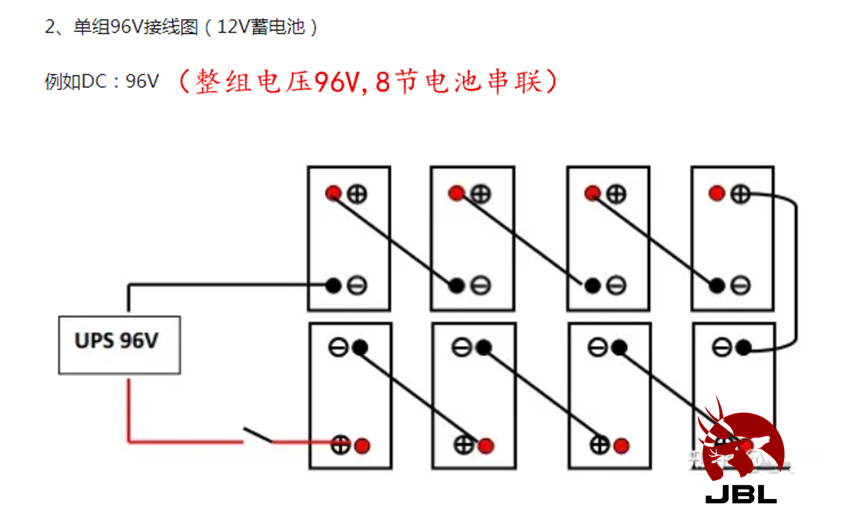
Voltage adaptation : Make sure that the voltage of the selected battery matches the voltage required by the UPS system design. Different UPS systems will design specific battery pack voltages based on their power, performance and other factors, such as common 12V, 24V, 48V, etc. In practical applications, multiple batteries are connected in series or parallel to form a voltage level that meets the needs of the UPS. If the battery voltage does not match the UPS system, the UPS may not work properly or even damage the equipment.
Brand and quality : Give priority to well-known brands of UPS batteries, such as Sacred Sun, Kehua and other brands. Well-known brands usually have better guarantees in terms of product quality, performance stability and after-sales service. High-quality batteries can provide more stable power output, have longer service life, reduce UPS system abnormalities caused by battery failure, and reduce maintenance costs and risks. When purchasing, purchase through formal channels to avoid purchasing fake and shoddy products.
environmental adaptability : Consider the impact of the actual usage environment of the UPS system on the battery. If the ambient temperature is high, you should choose a battery with better high temperature resistance, because high temperature will accelerate the aging of the battery and shorten its service life. ; In a humid environment, choose a battery with good moisture-proof performance ; If there are vibrations in the application scenario, you need to choose a battery with strong earthquake resistance to ensure that the battery can still operate stably in complex environments and play its due role in energy storage and power supply.
If you have any more in-depth questions about UPS power supplies, Kehua products or UPS batteries, such as detailed parameters of specific models, comparisons of batteries of different brands, etc., please feel free to consult me at any time.